Introduction
Managing financial operations in a large organization requires more than traditional accounting software. As companies expand across multiple departments, locations, and markets, they need a centralized platform that can handle complex financial processes, automate workflows, improve reporting accuracy, and provide real-time business insights.
Enterprise Resource Planning (ERP) software has become an essential technology for organizations seeking better operational control. Among the leading cloud ERP platforms available today, Oracle NetSuite ERP is recognized as one of the most comprehensive solutions for large businesses and growing enterprises.
Oracle NetSuite combines financial management, accounting, customer relationship management (CRM), inventory, supply chain management, e-commerce, project management, and business analytics into a single cloud-based platform. This integrated approach allows companies to manage their entire business ecosystem without relying on multiple disconnected applications.
In this comprehensive review, we will explore Oracle NetSuite ERP’s features, pricing, advantages, disadvantages, and determine whether it is the right cloud accounting and ERP solution for large businesses in 2026.
What Is Oracle NetSuite ERP?
Oracle NetSuite ERP is a cloud-based enterprise resource planning platform developed by Oracle. It is designed to help medium-sized and large organizations manage complex business operations through a unified system.
Unlike traditional accounting software that focuses mainly on bookkeeping and financial transactions, NetSuite provides a complete business management environment.
The platform supports:
- Financial accounting
- Revenue management
- Inventory management
- Supply chain operations
- Customer relationship management
- Human resources
- Project management
- E-commerce operations
- Business intelligence
Because NetSuite operates entirely in the cloud, businesses can access their data from anywhere while benefiting from automatic updates, centralized information, and scalable infrastructure.
Key Features
1. Advanced Financial Management
Financial management is the foundation of Oracle NetSuite ERP.
The platform provides powerful accounting capabilities, including:
- General ledger management
- Accounts payable
- Accounts receivable
- Cash management
- Fixed asset management
- Budgeting
- Financial consolidation
- Multi-currency accounting
- Tax management
These features allow large organizations to maintain accurate financial records across different departments and regions.
2. Real-Time Financial Reporting
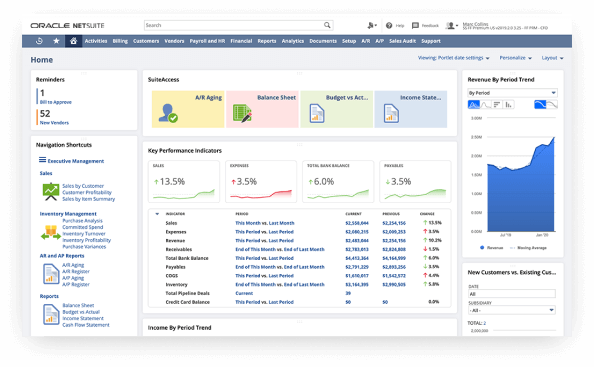
One of NetSuite’s strongest advantages is its advanced reporting capabilities.
Businesses can access reports such as:
- Profit and Loss statements
- Balance sheets
- Cash flow analysis
- Revenue reports
- Budget comparisons
- Financial forecasts
- Department performance reports
- Consolidated financial statements
Real-time reporting allows executives and finance teams to make faster, data-driven decisions.
3. Multi-Company and Global Accounting
Large organizations often operate across multiple countries, subsidiaries, and business units.
Oracle NetSuite supports:
- Multi-company accounting
- Multiple currencies
- Global tax management
- International financial consolidation
- Regional compliance requirements
- Intercompany transactions
These capabilities make NetSuite suitable for multinational organizations with complex financial structures.
4. Inventory and Supply Chain Management
For companies managing physical products, inventory control is essential.
NetSuite provides tools for:
- Inventory tracking
- Warehouse management
- Demand planning
- Order management
- Procurement
- Stock optimization
- Supply chain visibility
These features help businesses improve efficiency while reducing inventory costs.
5. Customer Relationship Management (CRM)
NetSuite integrates CRM functionality directly into the ERP platform.
Businesses can manage:
- Customer information
- Sales opportunities
- Marketing campaigns
- Customer service
- Sales forecasting
- Customer interactions
Having CRM and ERP data in one system provides a complete view of customer relationships.
6. E-Commerce Management
Modern businesses often operate through multiple sales channels.
NetSuite supports e-commerce operations by helping businesses manage:
- Online stores
- Product catalogs
- Orders
- Customer data
- Inventory synchronization
- Digital transactions
This makes it easier for companies to connect online sales with financial and operational systems.
7. Project Management
Organizations that provide professional services can benefit from NetSuite’s project management tools.
Features include:
- Project tracking
- Resource allocation
- Time management
- Project billing
- Expense monitoring
- Profitability analysis
These capabilities help companies manage projects more efficiently.
Ease of Use
Oracle NetSuite offers a professional interface designed for enterprise users.
The platform includes:
- Custom dashboards
- Role-based access
- Personalized workflows
- Business reports
- Analytics tools
However, because NetSuite is a sophisticated ERP system, implementation and training are often necessary. Organizations typically work with consultants or implementation partners to configure the system according to their business processes.
Once properly implemented, many users find the platform highly efficient for managing complex operations.
Automation Capabilities
Automation is one of the biggest benefits of NetSuite ERP.
The system can automate:
- Invoice processing
- Payment workflows
- Financial consolidation
- Approval processes
- Revenue recognition
- Inventory updates
- Reporting tasks
- Customer communications
Automation reduces manual work, improves accuracy, and allows employees to focus on higher-value activities.
Cloud-Based Advantages
As a cloud ERP platform, NetSuite offers several benefits compared with traditional on-premise systems.
Advantages include:
- No need for internal server infrastructure
- Automatic software updates
- Remote accessibility
- Scalability
- Centralized data management
- Easier collaboration between teams
These features make NetSuite attractive for organizations operating in dynamic business environments.
Security Features
Enterprise businesses require strong protection for financial and operational data.
Oracle NetSuite includes security features such as:
- Data encryption
- Role-based permissions
- Multi-factor authentication
- Audit trails
- Secure cloud infrastructure
- Regular system updates
- Data backup procedures
These features help organizations maintain security and compliance standards.
Integration Capabilities
NetSuite supports integration with various business applications and platforms.
Common integrations include:
- Payment processing systems
- E-commerce platforms
- CRM applications
- Human resource software
- Business intelligence tools
- Warehouse management systems
- Industry-specific applications
These integrations allow businesses to customize NetSuite according to their operational requirements.
Pricing
Oracle NetSuite pricing is customized based on business requirements.
Costs depend on factors such as:
- Number of users
- Selected modules
- Business size
- Industry requirements
- Implementation services
- Customizations
- Support packages
Unlike basic accounting software with simple monthly pricing, ERP platforms like NetSuite usually require a larger investment due to implementation, configuration, and training requirements.
Although the initial cost may be significant, many organizations view NetSuite as a strategic investment that improves efficiency and supports long-term growth.
Pros
Oracle NetSuite ERP offers many advantages:
- Complete cloud-based ERP platform
- Powerful financial management
- Real-time reporting
- Global accounting capabilities
- Strong automation features
- Excellent scalability
- Integrated CRM and ERP functions
- Advanced inventory management
- Suitable for multinational organizations
- Regular platform improvements
Cons
Despite its powerful capabilities, NetSuite has some limitations:
- Higher cost compared with traditional accounting software.
- Implementation can require significant planning and professional assistance.
- Smaller businesses may find the platform too complex.
- Customization and additional modules can increase expenses.
- Users may need extensive training to maximize functionality.
These considerations are common among enterprise-level ERP solutions.
Best Businesses for Oracle NetSuite ERP
Oracle NetSuite is particularly suitable for:
- Large enterprises
- Growing international companies
- Manufacturing organizations
- Wholesale businesses
- Retail chains
- Software companies
- Professional service providers
- E-commerce businesses
- Organizations managing multiple subsidiaries
Companies requiring centralized financial and operational management will benefit most from NetSuite.
Customer Support
Oracle NetSuite provides various support resources, including:
- Technical support services
- Online documentation
- Training programs
- Knowledge resources
- Community forums
- Implementation partners
- Professional consulting services
Because ERP systems affect many business processes, reliable support plays an important role in successful implementation.
Is Oracle NetSuite ERP Worth It in 2026?
Oracle NetSuite ERP remains one of the leading cloud ERP solutions for large businesses in 2026.
Its ability to combine accounting, financial management, inventory, CRM, e-commerce, and analytics into one platform makes it a powerful choice for organizations seeking operational efficiency and scalability.
However, NetSuite is not designed for every business. Small companies with simple accounting needs may find solutions like QuickBooks Online, Xero, or Zoho Books more practical.
For large organizations that require advanced automation, global financial management, and real-time business visibility, Oracle NetSuite can provide significant long-term value.
Oracle NetSuite ERP vs. Other ERP and Accounting Solutions
Compared with platforms such as SAP Business One, Microsoft Dynamics 365 Business Central, QuickBooks Online, and Xero, Oracle NetSuite focuses strongly on enterprise-level cloud business management.
SAP Business One is popular among SMEs requiring integrated ERP capabilities, while Microsoft Dynamics 365 Business Central provides strong integration with the Microsoft ecosystem. QuickBooks Online and Xero are better suited for smaller businesses seeking straightforward accounting solutions.
Oracle NetSuite differentiates itself through its fully cloud-based architecture, global financial capabilities, extensive automation, and ability to manage complex organizational structures.
Final Verdict
Overall Rating: 4.8/5
Pros
- Comprehensive cloud ERP platform
- Powerful accounting and financial tools
- Excellent global business support
- Advanced reporting and analytics
- Strong automation capabilities
- Scalable for enterprise growth
- Integrated CRM, inventory, and e-commerce features
Cons
- Higher investment compared with basic accounting software
- Complex implementation process
- Requires user training
- May be excessive for small businesses
Conclusion
Oracle NetSuite ERP remains one of the most powerful cloud accounting and enterprise resource planning solutions available in 2026. Its combination of financial management, automation, analytics, inventory control, CRM, and global business support makes it an excellent choice for large organizations seeking a centralized platform to manage complex operations.
Although the investment and implementation process are more demanding than traditional accounting software, businesses that require scalability, efficiency, and real-time visibility can gain substantial value from NetSuite. For companies planning long-term growth and digital transformation, Oracle NetSuite ERP is a reliable and future-ready business management solution.